
The USE IT Act Clock Is Running. Is Your Agency Ready?
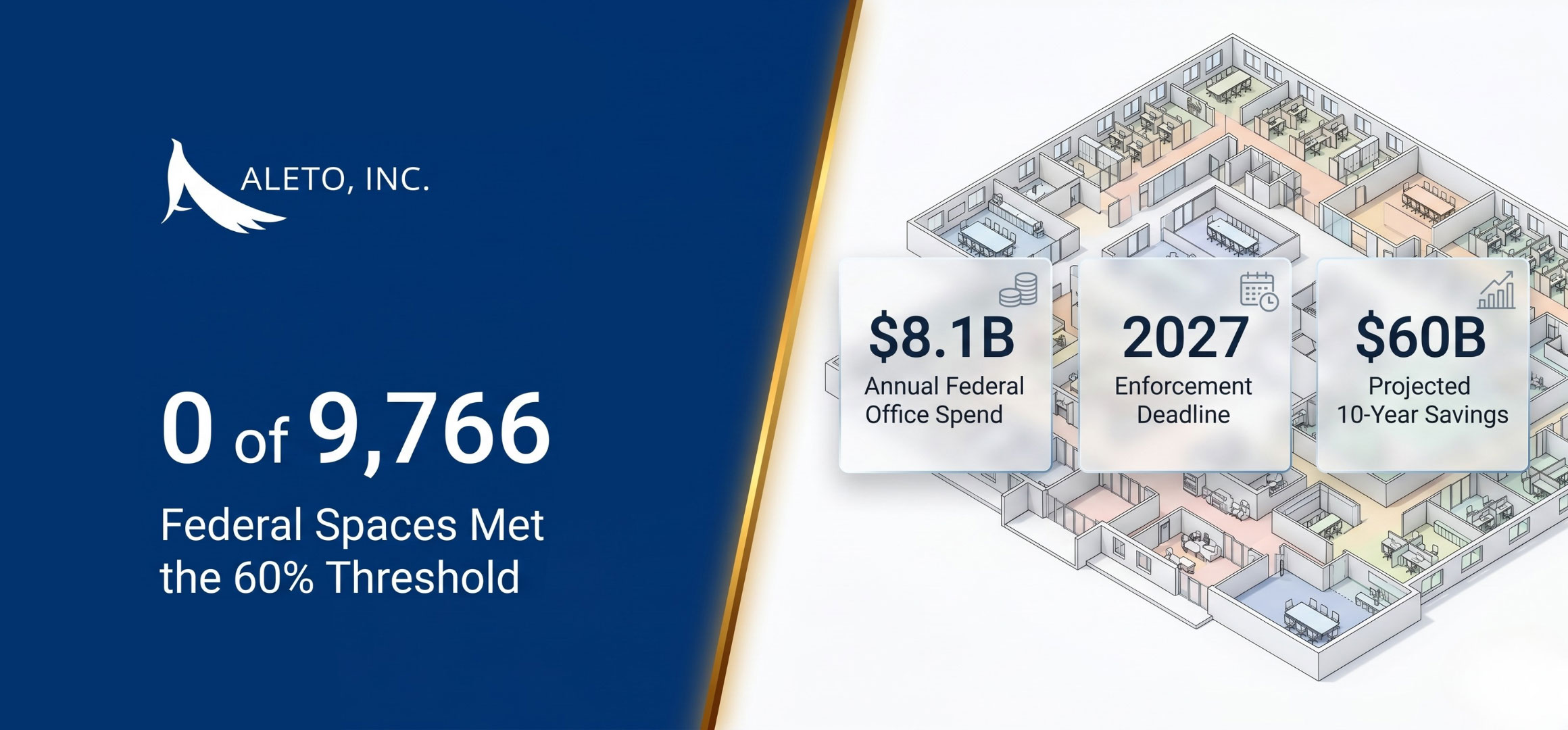
Zero out of 9,766 federal spaces met the 60% utilization benchmark in 2026. Every covered agency is now inside the enforcement window. Here’s your ROI blueprint for compliance—and for turning mandate into strategic advantage.
GSA Multiple Award Schedule Holder | 1.5M+ Square Feet Optimized | $50M+ in Client Cost Avoidance

USE IT Act Compliance for Federal Agencies: Automate Reporting, Protect Your Portfolio
The USE IT Act (effective January 4, 2025) requires federal agencies to report building utilization biweekly and maintain a 60% average annual occupancy rate. GSA’s March 2026 data confirmed zero of 9,766 reported spaces met the threshold. Aleto helps agencies automate compliant reporting via IWMS and transform utilization data into portfolio savings.
What Is the USE IT Act and Why Does It Affect Every Federal Agency Right Now?
The Use Space Efficiently and Improving Technologies (USE IT) Act — Section 2302 of the Thomas R. Carper Water Resources Development Act of 2024 — became effective January 4, 2025. It mandates that federal agencies precisely measure the utilization of their office space and report that data biweekly to GSA, OMB, GAO, and Congress.
The compliance standard is unambiguous: agencies must maintain at least a 60% average annual building utilization rate. GSA’s March 2026 public data release confirmed that not a single one of 9,766 reported federal spaces had met this benchmark at the close of the first 12-month reporting period. Every covered agency is currently inside the enforcement window.
Beginning in early 2027, the GSA Administrator — in consultation with the OMB Director — is statutorily required to take steps to reduce the space of non-compliant agencies.
Key Numbers Federal Real Property Officers Need to Know
| Metric | Figure | Source |
|---|---|---|
| Federal spaces meeting the 60% threshold (March 2026) | 0 of 9,766 | GSA USE IT Act Data Release, March 31, 2026 |
| Annual federal government office spend | $8.1 billion | OMB Report to Congress, August 2024 |
| Projected 10-year savings from 30% portfolio reduction | $60 billion | Robin Carnahan, GSA Administrator, January 2025 |
| GSA leases expiring 2025–2029 | 70M+ sq ft | OMB Report to Congress, August 2024 |
| Federal deferred maintenance backlog (FY2024) | $370 billion | OMB Report to Congress, August 2024 |
| Enforcement deadline | Early 2027 | USE IT Act, Section 2302 |
How Is USE IT Act Building Utilization Calculated?
The compliance threshold is frequently misunderstood. The 60% standard does not mean 60% of seats must be filled. It means 60% of a building’s calculated capacity — total usable square footage divided by 150, the federal design standard per person — must be physically present on an average day. For many agencies, that bar is significantly higher than initial estimates suggest.
The Compliance Formula Step by Step
| Step | What It Calculates | Example: 75,000 sq ft Building |
|---|---|---|
| Step 1: Measure usable space | Building Usable Square Footage (USF) | 75,000 sq ft |
| Step 2: Divide by 150 | Federal design standard per person | = 500-person building capacity |
| Step 3: Apply 60% rule | Capacity × 60% minimum utilization | = 300 people required daily on average |
| Step 4: Assess risk | If fewer than 300 present on average | Enforcement risk begins |
A building that seats 200 people at workstations may have a legal capacity of 500 — meaning 300 people must be present daily, on average, to remain compliant. That gap is where agencies are most exposed.
Why Spreadsheets and Manual Badge Exports Cannot Meet the Mandate
Manual compliance workflows — pulling badge exports, cross-referencing space assignments, applying exclusion rules, and formatting OMB Collect templates — consume an estimated 4 to 10 labor hours per building per biweekly cycle.
For a 15-building portfolio, that translates to $36,000–$90,000 in fully-loaded GS-12 labor costs per year. Across all government-reported spaces, the aggregate manual burden could reach tens of millions of dollars annually.
Beyond labor cost, OMB guidance is explicit that accuracy of occupancy counts is imperative. The most common accuracy failures include:
- OA-to-space mappings not updated following floor re-stacks or renovations
- Incorrect USF calculations due to outdated floor plans or reclassified room types
- Bureau names that don’t match the GSA master list exactly, causing submission rejections
- Inability to correctly allocate occupancy counts when multiple Occupancy Agreements share a building
- Undocumented exclusions for mission spaces, renovation zones, and national-security assets
The root cause of most compliance failures is not a malfunctioning sensor. It is the absence of a single authoritative record for buildings, spaces, identifiers, and square footage.
How IWMS Automates USE IT Act Compliance and Delivers Strategic Value
An Integrated Workplace Management System (IWMS) is not a sensor or a badge reader. Its value lies in functioning as the agency’s single system of record — and as the integration hub that normalizes telemetry from every occupancy data source into certified, OMB-ready outputs.
Every M-25-25 requirement maps to a specific IWMS capability:
M-25-25 Compliance Capability Map
| M-25-25 Requirement | What Agencies Must Provide | How IWMS Delivers It |
|---|---|---|
| Biweekly submission automation | Daily headcounts per OA/RPUID via OMB Collect every pay period | Aggregates badge and sensor data; validates formatting and bureau names; exports compliant Excel templates automatically |
| Space inventory & USF tracking | Office USF per OA/RPUID; BOMA/ANSI classification; exclusion of non-office space | CAD/BIM-linked floor plans with automated USF calculation and room-type classification |
| Multi-OA allocation | Occupancy allocated separately per OA when multiple share a building | Maintains separate inventories per OA; applies proportional allocation where sensor data cannot delineate |
| 60% threshold monitoring | Annual average must meet or exceed 60% | Real-time dashboards surface at-risk buildings; exception workflow documents mission-space justifications |
| Annual narrative report | Agency-level submission to OMB and Congress with methodology | Report generator compiles audit-ready narratives from stored method metadata and confidence scores |
Source: GSA USE IT Act and Occupancy Data Portal – Reporting Guidelines
The Business Case for IWMS — Beyond Compliance
| Value Category | Challenge Without IWMS | Impact With IWMS |
|---|---|---|
| Manual Reporting Labor | $36,000–$90,000/year per 15-building portfolio at GS-12 rates; 15+ corrections/cycle at $291/error | 80% less administrative time; 84% faster audit preparation |
| Facility Management Costs | $8.1B/year federal office spend; $370B deferred maintenance backlog | 10–35% facility cost reductions; up to 42% space utilization improvement |
| Portfolio Right-Sizing | 70M+ sq ft of GSA leases expiring 2025–2029 — the largest near-term optimization window in decades | Data-informed consolidation, lease exit, and capital decisions before the 2027 enforcement deadline |
| Enforcement Cost Avoidance | Two consecutive below-60% years triggers mandatory GSA space reduction | IWMS-informed consolidation preserves agency flexibility and mission continuity |
Why Agencies We Support Choose Aleto for USE IT Act Readiness
Agencies we support have leveraged Aleto’s combination of IWMS expertise and real-world execution to identify underutilized space, evaluate data-driven options, and execute decommissioning and consolidation strategies for more than 1.5 million square feet — resulting in over $50 million in cost avoidance and savings.
Aleto provides enterprise-level support across the full federal real property lifecycle: early portfolio assessments and compliance planning, ongoing IWMS management and optimization, biweekly reporting support, and decommissioning and close-out. Our approach aligns IWMS data intelligence with design, move, and construction execution — ensuring that compliance decisions are realistic, achievable, and operationally sound.
The 2027 Enforcement Deadline Is Not Hypothetical
At the close of the second one-year reporting period in early 2027, GSA and OMB are required by statute to forcibly reduce the space of agencies that have not met the 60% threshold for two consecutive years. Agencies that act now will control their real estate decisions. Agencies that wait risk having those decisions made by statute.
Contact Aleto to assess your agency’s USE IT Act compliance posture:
-
- Luis Viera, President: luisv@aletosolutions.com
- Lauren Ross, Account Director – Space:
Frequently Asked Questions — USE IT Act and Federal IWMS Compliance
Download the Full White Paper
Ready to move from reactive compliance to proactive real estate control?

Luis Viera, President
luisv@aletosolutions.com

Lauren Ross, Account Director – Space
lauren@aletosolutions.com
Luis Viera
President
Luis Viera is President of Aleto, Inc., where he leads the firm's federal real estate optimization and workplace strategy practice. He works with federal agencies on USE IT Act compliance, IWMS-driven portfolio decisions, and large-scale space consolidation, helping clients turn occupancy mandates into measurable cost avoidance. Under his leadership, Aleto has optimized more than 1.5 million square feet of federal space and delivered over $50 million in client cost avoidance. Reach him at luisv@aletosolutions.com.
Lauren Ross
Space and Workplace Management Systems
Lauren Ross leads Aleto's space and workplace management systems engagements, advising federal agencies on occupancy reporting, IWMS implementation, and USE IT Act readiness. She helps real property teams translate biweekly utilization data into defensible, OMB-ready reporting and portfolio decisions. Reach her at lauren@aletosolutions.com.
Posted on: May 7, 2026
